
Engineering a better roast
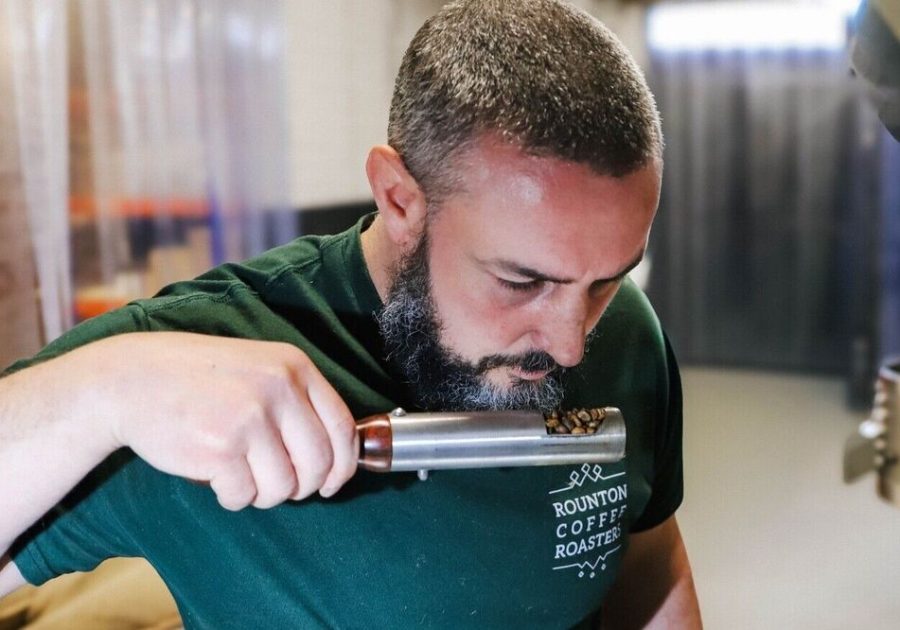
When David Beattie talks about roasting coffee, he sounds less like a barista and more like the chemical engineer he was in his former life.
Heat transfer. Airflow. Fuel efficiency.
Not exactly what most people think about when brewing their morning cuppa.
But inside Rounton Coffee’s rural North Yorkshire headquarters, engineering drives almost every decision.
And recently, the company made one of its biggest decisions to date.
Cleaner technology cuts fuel use and emissions
Having started life selling coffee at farmers’ markets, Rounton has invested £150,000 in a new state-of-the-art roasting machine.
 The California-built Loring Smart Roast S35 Kestrel roasts beans from across the ‘Coffee Belt’ – and even China – inside Rounton’s farmhouse-turned-roastery.
For Rounton Coffee, that investment will hopefully lead to lower emissions and bills – with the machine eventually paying for itself.
“When we decided to invest in a new coffee roaster, it was a significant decision for us as an independent business,” explained David.
“At our scale, this kind of purchase has long-term implications, so we spent a long time thinking about what would genuinely improve the quality of the coffee we roast, as well as how efficiently we operate.”
Before launching Rounton Coffee, David worked in chemical engineering, holding a senior role at Europe’s largest industrial gas production facility in Teesside.
“Having that background meant we approached roasting by focusing on heat transfer, control and consistency rather than tradition alone,” he said.
“The machine we ultimately chose suits our production requirements, while also aligning with our ambition to roast cleaner-tasting coffee with a lower carbon impact.”
Within speciality coffee, Loring machines have established quite a reputation.
They are often described as “smokeless” roasters, although Dave says that isn’t quite accurate.
Convection roasting protects flavour and quality
Most traditional coffee roasters work by spinning beans inside a hot metal drum, as gas burners heat them externally.
Smoke created during roasting is often dealt with separately through another machine called an afterburner.
However, Loring combines all this.
 That design is what makes the machine so efficient.
Rather than constantly pushing hot air outside and replacing it with cold air, the Loring recycles much of its heat back through the system.
“The same gas burner produces hot air for roasting and incinerates smoke internally as part of the airflow path,” explains Dave.
“Rather than venting exhaust straight out, a large proportion of the air is recirculated and passed back through the burner zone before being reused or exhausted.”
In simple terms, less heat is wasted.
And that has a major impact on fuel bills – not a bad upside in the current climate.
Loring claims its machines can use up to 80 per cent less fuel than traditional drum roasters fitted with separate afterburners.
For a growing coffee business roasting large volumes every day – in Rounton Coffee’s case, as much as a tonne – those savings are very accountant-friendly.
“This integrated approach is one of the main reasons the Loring can achieve significantly lower fuel consumption,” said Dave.
“Fewer burners are running, less cold air needs reheating, and more of the energy going into the system is doing useful work.”
At a time when energy costs remain wildly unpredictable, with little sign of that changing, that matters.
A lot.
 Roasting coffee is energy intensive, particularly for speciality businesses producing large batches every day.
Reducing gas use does not just lower emissions. It also cuts running costs significantly over time.
And as manufacturers increasingly come under pressure to reduce their carbon footprint, investments like this could eventually create opportunities around carbon credits and sustainability reporting too.
And then there’s the other big factor – taste.
“Cup quality was equally important, and this is where the fundamental difference between conductive and convective heat really matters,” he added.
“Conductive heat is inherently aggressive.”
“When beans are heated through direct contact with very hot metal surfaces, it becomes difficult to avoid localised overheating.
“This is where defects such as scorching and tipping commonly arise.”
And unsurprisingly, defects can have a nasty impact on taste – not ideal for a company whose beans scooped eight Great Taste awards last year.
“In the cup, these defects tend to present as heavier, roasty, sometimes carbonised flavours that mask the coffee’s natural character and origin expression,” noted Dave.
But the Loring works differently because it relies far more heavily on hot air moving around the beans.
“With a convection-led system, heat transfer is much gentler and more uniform,” said Dave.
“Hot air surrounds the bean evenly, and adjustments to heat input and airflow take effect quickly and predictably.”
For speciality coffee businesses like Rounton, that’s vitally important.
Modern coffee drinkers increasingly want to taste where a coffee comes from – whether that is fruity Ethiopian beans or sweeter South American varieties – rather than just tasting roast flavour.
Rounton’s tasting notes suggest those flavours are worth bringing out; Plum, grapefruit, honeydew melon and redcurrant are just to name a handful of the flavours emitted from the company’s organic beans.
And according to Dave, the new machine helps preserve those differences.
“Instead of being dominated by roast character, coffees retain more of what makes them distinctive,” he added.
“Acidity is better defined, sweetness is clearer, and origin-specific flavours are far more evident.”
Scaling growth through efficiency and precision
For Rounton Coffee, that engineering-led approach is now helping power a rapidly growing business.
The company is now packing approximately 2,000 bags of coffee each week – shipping some as far as the Outer Hebrides – while the new roaster has allowed them to scale up their subscription service which has seen subscriber numbers double in the past year.
But perhaps more importantly, it reflects a wider shift happening across food and drink manufacturing.
For years, sustainability was often seen as expensive or difficult.
And also, a bit of a buzzword.
Now, businesses are increasingly finding that greener technology can also improve quality and lower costs at the same time.
For Rounton Coffee, the new roaster is proof of that.
